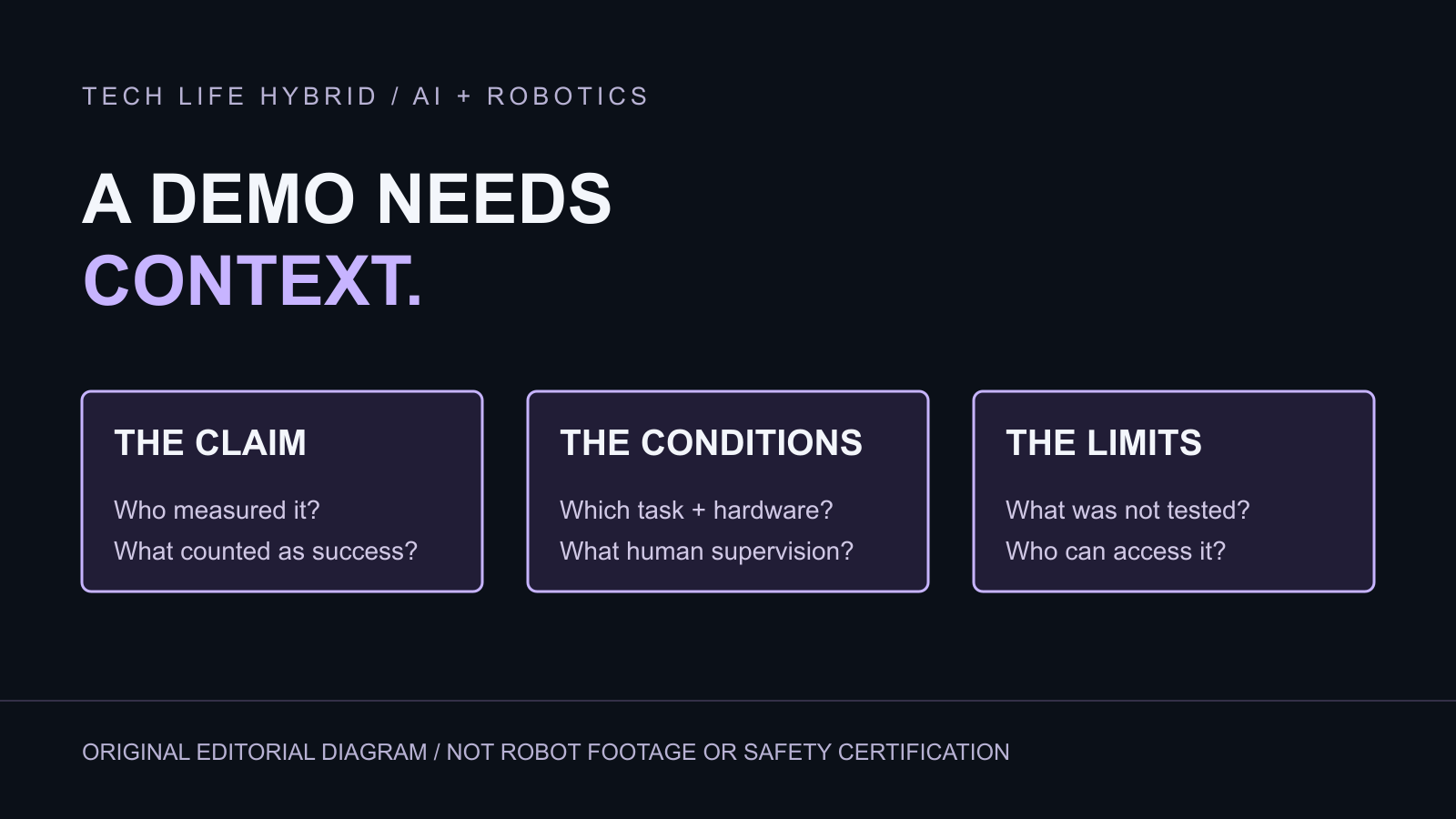
What changed—and when
Google DeepMind announced Gemini Robotics 2.5 on November 10, not today. It describes a vision-language-action model rolling out to robotics partners. The company reports evaluations across more than 200 tasks and a 96% pick-and-pack success rate in a Mercedes-Benz proof-of-concept using Apptronik's Apollo 2. Those are company-reported results for described conditions, not Tech Life Hybrid measurements.
A result is not universal compatibility
A successful demonstration does not establish that an unrelated robot arm, controller, gripper or workspace will behave the same way. Ask which hardware, sensors, objects, supervision and failure cases the result covers. A percentage without its test conditions cannot tell you whether a robot is ready for a different job.
A better project brief
Our suggested evaluation sheet has five fields: a narrowly defined task, permitted operating conditions, a measurable success rule, a human stop procedure and a failure log. Keep simulation results separate from physical trials. Do not let an AI model's output bypass the hardware's documented safety controls. Industrial installations require qualified assessment; this news brief is not a wiring or commissioning guide.
What we have not verified
We have not operated this model, independently reproduced its task results or established public access for a home project. DeepMind also describes new safety work, but a benchmark is not certification that a deployment is safe around people. Read the developer's full evaluation context before turning a demonstration into a purchase or build decision.