Today's source is about the process
Raspberry Pi's November 20 Ask an Engineer interview describes how its engineers develop hardware. The discussion separates early prototypes, feature-complete revisions and pre-production work, while explaining that test failures or component availability can require further redesign. It is an interview about engineering—not a launch of a new microcontroller board.
The lesson for your bench
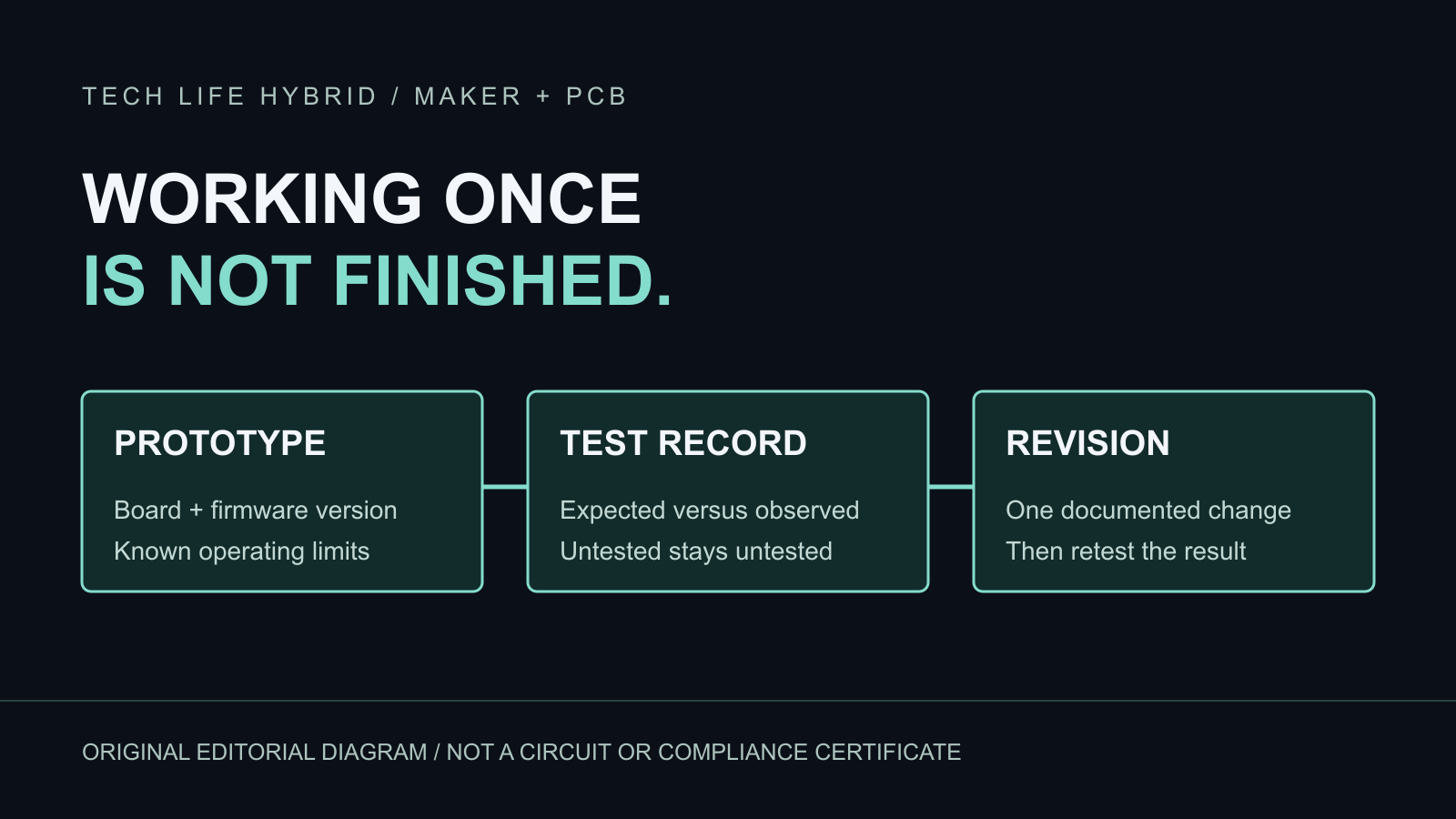
A board powering on once is one observation, not evidence that every connection, firmware path and operating condition has been checked. For a small Arduino or Raspberry Pi project, keep the schematic revision, PCB revision, board model and firmware version together. Label a problem precisely before changing several things at once.
Make the next revision explain itself
Our suggested change record is simple: what failed, how to reproduce it, the proposed change, the expected result and the actual retest result. Keep untested entries marked untested. Photograph the unpowered build for your own reference, excluding personal labels or account information. Do not present this paperwork as compliance certification or a guarantee that a circuit is safe.
Start within a safe learning boundary
Use the documented low-voltage learning paths in Micro Bench and the PCB desk. Check the exact board's logic levels and pinout before wiring; disconnect power before altering connections. Mains power, battery-pack design and high-current motor systems are outside this brief. Tech Life Hybrid has not built or tested a circuit as part of reporting this interview.